If you've been running a couple of half marathons, and you want to challenge yourself and increase your distance to a full marathon, this post is for you! For those who have only been running 10km so far, you can use the tips from this post to get you to the half marathon distance (: If you're just starting out your fitness journey, read my post here for other tips!
Doubling your distance from a half to a full marathon seems daunting, but with consistent training, you'll eventually be able to get there, and survive the full marathon distance well! It took me a few months to train up my body to endure the distance, so here's my training plan, for those of you who feel that you don't know what to do.
Up till 3 months prior to race day:
Have a mix of different types of runs -
I always do at least one of each type every week (which means I run at least 3 times a week) - sprint intervals, tempo run, long distance run.
For sprint intervals, I usually do 6 x 400m, with 100% rest time in between. This means that if you take 2 min to run 400m, you will rest 2 min before running the next lap. You can always modify this and lengthen/shorten the distance of each lap, or increase/decrease the number of laps. Sprints are the best way to increase your speed.
Tempo runs are slightly longer than sprints. They're meant to increase your functional threshold and train you to run longer at a faster pace. This should be about 30s per km faster than your normal race pace, but slower than sprints. I started out with 2 x 2km, then progressed on to 2 x 2.5km and then 2 x 3km, with a 100% rest in between as well. Once you're able to do that, you can also do the full 6km at the faster pace.
Long distance runs are great for recovery. I usually do them in between my sprint intervals and tempo run because the other two types of training will give you aches, so you need to do the long run to recover. My long runs started out being only 10km, then I slowly increased my distance by 2km. Once I'm comfortable with the increased distance, I will then increase by another 2km. You should run these at your normal race pace and it should be fully aerobic.
For me, I get sick of running quite easily, so I need to vary my exercises. On the other days when I'm not running, I will do other forms of strength training - core, legs, arms. All these muscle groups are essential for running as well, because they help to maintain your posture and prevent injuries from occurring due to bad posture while running. I also cycle and swim.
Less than 3 months to race day:
This is when I start to cut the strength and speed portions of my training and focus on the distance. I sprained my ankle ligament last year due to a sudden increase in my running distance, causing a huge strain on my ankle. Hence, I was very cautious this year so that I wouldn't injure myself before or during the full marathon.
Once a week, I would elongate my distance to train my endurance. 3 months = 12 weeks. This was what my plan looked like:
2-8 September - 12km
9-15 September - 15km
16-22 September - 18km
23-29 September - 21km
30 Sept - 6 October - 15km (in Japan)
7-13 October - 17km (in Japan)
14-20 October - 21km
21-27 October - 25km
28 Oct - 3 November - 21km (Great Eastern Women's Run)
4-10 November - 30km
11-17 November - 35km
18-24 November - 27km
25-29 November - 10km
30 November - Full Marathon race day
I didn't stick to this strictly though, because you really need to see how your body recovers. For example, when I came back from my trip in Japan, my body was tired and couldn't do a 21km that week, so instead of 25km the following week, I cut it down to 21km instead. Also, my feet didn't recover sufficiently and we had bad nutrition planning before the 35km run, so it ended up being only 33.5km. That was the longest run I did before the actual full marathon.
You need not follow my plan. I had some ups and downs due to a holiday and another half marathon race on 3 November. The most important thing is to increase the distance gradually and listen to your body. Also, about 3 weeks to the race day, remember to train at the timing of the race. Mine was an evening race, so I had to get used to running at that timing.
What did I do for the other runs in the week other than the one long run? I stuck to 10-12km runs. My total mileage per week was about 50km. My feet really started to hurt over time and that was something I couldn't get rid of, until the full marathon was over. I just massaged them and let them recover just enough so that they wouldn't hurt when I ran. That's why it's extremely important to increase the distance gradually, otherwise your body would be in shock from the distance and it might cause more injuries.
Another tip: your shoe is VERY important. Choose the correct shoe. I decided to try a new brand of shoes because my previous pair was wearing out. The first few runs were okay, but after awhile when I started to run longer distances continuously, I found that the same area on the base of my feet started to hurt very badly. That's when I decided that the shoe wasn't suitable for me and I had to change my shoe. I ended up buying the same model of shoe, but the newer version (Asics Gel Kayano 26) and the pain went away. Once you've found a pair that works for you, just stick to it!
There you go! I hope this post helps you as you train for your full marathon (: It's really not that bad! Just train consistently and you will get there.

Showing posts with label sports. Show all posts
Showing posts with label sports. Show all posts
Standard Chartered Singapore Marathon 2019 Race Report: My first full marathon!
In a bid to double my distance every year since 2016, I wanted to sign up for a full marathon this year, and what better race to start it with than THE Singapore Marathon, right? So when registrations opened earlier this year, I immediately signed up before I started to question my decision.
D-1 to race day: Race pack collection @ Marina Bay Sands Expo
The race pack collection was extremely efficient - there were separate queues for all the various types of races, so it disperses the crowd. There were also many counters to speed up the whole process! I didn't have to queue at all (but I also went at an odd hour). After the collection, you'll be directed to the merchandise area, where I bought a pair of socks because they were reasonably priced at $17 and I didn't really have very good running socks. From there, the next section would be the Standard Chartered section with plenty of photo opportunities! Also, dutch colony was giving out free drinks (coffee/tea/chocolate). The last section was the partners area, which interested me the most! It was huge and the traffic flow was well directed because you need to follow a certain path, which made going through the booths very orderly. Koda set up a booth where you could try the gels and energy bars, which was great because I wanted to see if their gels suited me before taking them during the race itself. There were also many other running events organisers that set up booths to promote overseas races! I was rather drawn in by those because I can travel and run at the same time :P Shall try for one next year! Overall, this is the most interesting race pack collection I have ever experienced, because of the sheer number of partners involved.


Also, some pictures courtesy of finisherpix, though I'm too poor to download them in high res.


D-1 to race day: Race pack collection @ Marina Bay Sands Expo
The race pack collection was extremely efficient - there were separate queues for all the various types of races, so it disperses the crowd. There were also many counters to speed up the whole process! I didn't have to queue at all (but I also went at an odd hour). After the collection, you'll be directed to the merchandise area, where I bought a pair of socks because they were reasonably priced at $17 and I didn't really have very good running socks. From there, the next section would be the Standard Chartered section with plenty of photo opportunities! Also, dutch colony was giving out free drinks (coffee/tea/chocolate). The last section was the partners area, which interested me the most! It was huge and the traffic flow was well directed because you need to follow a certain path, which made going through the booths very orderly. Koda set up a booth where you could try the gels and energy bars, which was great because I wanted to see if their gels suited me before taking them during the race itself. There were also many other running events organisers that set up booths to promote overseas races! I was rather drawn in by those because I can travel and run at the same time :P Shall try for one next year! Overall, this is the most interesting race pack collection I have ever experienced, because of the sheer number of partners involved.


D-0 to Race Day: What to do prior to an evening race
There were 2 things I was concerned about - lethargy and nutrition. I've done one evening race in 2018, the ASICS relay, and I recalled that I felt heavy when I started running and developed a stitch during the race. Let's face it - everyone prefers to run in the morning when their muscles are all fresh as compared to the evening when they're worn out from a day's work. My other concern was my chronic gastritis, which has acted up during my evening trainings due to insufficient nutrition prior to the run. So I had to balance. I needed enough nutrition to not feel hungry, and yet not too much so that it would make me heavy or give me a stitch. For lethargy, afternoon naps usually give me a headache, so I had to make sure that my activities in the day were kept to a minimum but not make me feel sluggish.
The following plan worked for me. This is really personal and you need to know your body and how it functions and reacts, so the key is really to try various things BEFORE the race when you're doing your long distance trainings to see what works.
1. Breakfast at 10am - cereal. Light, but filled with carbs.
2. Lunch at noon - Japanese wafu pasta. Again, carb-heavy, but not cream-based.
3. Tea break at 3pm - bread. To me, bread is light but filling. I ate about 2-3 bun equivalents.
4. Pre-race nutrition at 5pm - Koda energy bar (half) and a banana for quick release energy.
I woke up at about 8+am (had about 8 hours of sleep) and didn't nap at all. I spent most of my day lounging around watching dramas, with the exception of walking 2-3km during lunch. I also made sure to shower before the race to feel fresh! I feel that it helps mentally, especially since Singapore is such a humid country.
Tip: give yourself at least an hour to get to the start point of the race. We ended up getting stuck in a jam and it doubled our travelling time. As a result, we JUST managed to make it into the start pen before it closed. It didn't really help emotionally because I was already worried about the race, and I had to worry about even reaching on time.
The race itself
I had familiarised myself with all the rest points that I needed to take nutrition (iso/water/gel). This was based on all the trial and error I had done previously during my training. I also went through the route in my head multiple times, so I roughly knew the landmarks for the various distances.
I started out well - clocking an average pace of 6:10 min/km, which was what I wanted. I managed to maintain this for the first 10-15km or so, taking my first nutrition intake of pretzel at the 11.6km rest point. (Side note: don't take all the pretzels. I didn't want to waste food so I held them in my hand and ate them as I ran but they were really too dry.) I think I was doing well till about the half marathon distance. I had planned to take my nutrition at the 23.6km mark, but ended up taking my GU gel (Caramel Macchiato) at the 21km mark instead because I needed it. Thereafter, I stopped at quite a number of rest points to take in iso and water because I was afraid of cramping and I had hit a wall in my speed - it dropped to about 6:30 min/km instead. From 25km onwards I maintained that pace throughout till the end, slowing down to 7 min/km if I stopped to take in nutrition. I had wanted to only take in water/iso every 4km, which is roughly every alternate rest point. However, due to the humidity and warm temperature due to increase in body heat of all the runners, I constantly felt the need to take in the cold liquids because they felt nice. That was a mistake because I ended up being too bloated on liquids and had to force myself to not take in any for awhile. Also, I was worried about cramping up halfway so I took in a lot of isotonic, which made my stomach feel weird towards the end. I think I could have gone without some. In the end, I took my food intake at these points - pretzel at 11.6km, caramel macchiato GU gel at 21km, cola vanilla Koda gel at 30km and Cappuccino Shotz gel at 37km. All my gels had caffeine in them to give me the adrenaline I needed in the second half of the race. My wall lasted from about the 25th to 35th km, then I got my second wind at around the 38thkm as I ran up Sheares bridge. This is the thing about slopes - DO NOT look up. It feels daunting when you do that and you might think that you're not able to do it. Just take it step by step. It's actually pretty gradual and you won't feel it as much as you think. I did a lot of slopes training previously when I was training for a hike and that really helped build muscles in my legs to take me up the slope with ease.
For the last few km, it's really all in the mind. I pushed on, knowing that I was nearing the end. I was a bit gutted by then, because I was aiming for 4h 30 min and I knew that I would not be able to make it, but I still tried my best anyway! During the last stretch, this girl who was running near me for about 7-8km or so suddenly shot out in front of me on my right. I was inspired and started sprinting like crazy for the last 50m or so, ending my marathon strong! I clocked 4:35:01, which ain't too bad for a first time, if I may say so myself. :P
There were a lot of lessons to be learnt, like do not over-drink isotonic and water, as well as do not eat pretzels because they are too dry. But I'm proud of what I've achieved, and that could only come with all the training that I've done in the months leading up to the marathon, mostly from September onwards.
A big thank you to the Ironman organisers for such a great event - there was no lack of gel, banana, water or isotonic drinks. There were also great performances along the way, which were interesting. Also a big thank you to my family for supporting me by live tracking me on the app and taking screenshots whenever I've cleared a checkpoint. I couldn't have done this without the support and company of my dearest, who trained with me, participated with me, and made the crazy decision to do this with me, even though in the end didn't do so well himself because he wasn't feeling well. Last but not least, all glory to God, because only He can give me the strength to run and also be my constant companion. When I hit the wall at the 25km mark, it was Him I turned to and I prayed through it.
My first marathon, and certainly not my last!


My extremely consistent pace:

Also, some pictures courtesy of finisherpix, though I'm too poor to download them in high res.


Fjällräven Classic Sweden Day 5: Kieron-Abisko
Day 5 started out in a slightly tired manner - having just been drenched and cold throughout the night, we weren’t extremely thrilled to pack all our dirty and wet stuff into the bag, much less wear our wet socks and boots. But we got up at 5am, packed up and ate breakfast anyway. We started walking at about 7am and since we knew it was only going to be 16km, we decided to take less breaks and kept a good pace for 6.5km before stopping for a brief brunch. Thereafter, we pressed on for another 5km, stopped for a brief water break and pushed on for the last bit.

In Abisko National Park, the terrain is a lot flatter and there are less rocks. It’s mostly just forested and the ground is mainly mud with rocks studded in between. Due to the heavy rain the night before and the occasional drizzle, we had to watch out for muddy puddles.

And...that was it! We completed it before noon! The atmosphere at the finish line was extremely warm. Those who had finished earlier and were hanging out at trekkers’ inn would cheer for anyone approaching the finish line. You’ll then get a drink and the final chop before receiving your medal, iron on patch and collar pin! You should also weigh in your trash bag because that's when you'll get your lucky draw ticket.

There are many other things at the finish line that you can look forward to:
Trekker's Inn...
Where they serve food, drinks (including alcoholic ones), and also music! There are some talks that will happen there so be sure to look out for that. The lucky draw at the end of everyday also occurs at Trekker's Inn. So, it's essentially the most happening place at the finish line.


Pop up stores...
There are several partners who will set up some booths in a Teepee, which is rather cool! I got to try some outdoor cooking food done by Elles Utemat using Primus stoves and grills, as well as get my boots treated by Han Wag.
I think that the entire area at the finish line is just a very good opportunity for interactions between new friendships formed and you should spend lots of time talking to the international friends you've just made, so make the most of it before you leave!
Read more about the Fjällräven Classic Sweden:
General Guide
Check in
Day 1
Day 2
Day 3
Day 4
Fjällräven Classic Sweden Day 4: Alesjaure-Kieron
And so it begins, Day 4 of the trek.
After a late night and a long hike the day before, we woke up at about 6.30am again, and left past 9am this time due to the inconvenience of the lack of a stream nearby and having to walk to the station for the water tank.
The trail follows along a lake, but the lake is NOT drinkable. It's considered a stale water body since the water collects in the lake, even though you'll see that the water is moving due to the wind. The trail from Alesjaure to Kieron has a dry portion in the second half, so you'll need to fill your bottle wherever possible. You can use the map given to look out for when the streams end.

The trail is mostly walking through shrubs on a wooden platform and the lake would be on your right for most of the trail. We knew that we only had 18km to cover that day, so we took it easy. After about halfway, we stopped for lunch at some rocks overlooking the lake. The view was spectacular, also because the sun was out at that time.


After the shrubs ended, the trail opened up to fields where reindeers could roam free (but we didn't see any, probably because there were too many people on the trail and it's not winter). We took a short break at 12km, which was the start of many problems later in the day. It started to drizzle after that short break and the drizzle became heavier. We were caught in that rain and by the time we got to Kieron, which comprised of a very steep down slope with wet mud due to the rain, we were completely soaked.

The Kieron checkpoint is right after a huge river crossing with a bridge, which is the only place where you can refill water in the surrounding area. I highly suggest you refill your bottles here before heading to the checkpoint. It'll save you quite a bit of walking later on.
At Kieron, the sun came back out and there were pancakes served! We had 2 rounds of pancakes (we were lucky, because they were actually controlling the pancake servings but we went when the volunteers changed shifts).

As a result of eating our 2 rounds of pancakes, we did not set up our tent when the sun was out. The weather changed to a sudden torrential downpour and we just stood there for a good half hour to an hour at least, shivering in the cold rain. We used our umbrellas and drank hot tea, which helped a bit but it was probably one of the most horrible experiences in my life.
When the rain lightened up slightly, we hurried and pitched our tent, but by that time we were all wet and dirty and our clothes were all soaked through because we learnt that our jackets were not waterproof enough. Neither of our pants is waterproof, so they were soaked as well. Our socks and the inside of our boots got soaked since the water from our pants dripped in and collected there. The worst part was that we placed our bags on some rocks, which were wet from the rain. Since our bags had other attachments on them, our rain covers did not stretch to the bottom. Hence, the water seeped in from the bottom of our bags. Though they were G-1000, the rain was simply too heavy. This resulted in our sleeping bags getting wet since they were at the bottom. A ton of other things were wet too, but they were thankfully in ziplock bags. We didn't eat dinner that night (at least we had 6 pancakes each) but just wiped down and dried ourselves and slept at 8pm. Since we didn't have our sleeping bags, we were way too cold and woke up every 1.5 hours or so, and even had to light the gas stove in our tent to warm up the place.
I think this night was rather memorable and we definitely learnt that we need better waterproof clothing, as well as to set up the tent whenever the sun is out!
Total distance covered on Day 4: 18.15km
Read more about the Fjällräven Classic Sweden:
General Guide
Check in
Day 1
Day 2
Day 3
Day 5
After a late night and a long hike the day before, we woke up at about 6.30am again, and left past 9am this time due to the inconvenience of the lack of a stream nearby and having to walk to the station for the water tank.
The trail follows along a lake, but the lake is NOT drinkable. It's considered a stale water body since the water collects in the lake, even though you'll see that the water is moving due to the wind. The trail from Alesjaure to Kieron has a dry portion in the second half, so you'll need to fill your bottle wherever possible. You can use the map given to look out for when the streams end.

One of the bigger streams after the Alesjaure station where you can refill your bottle. You also have to cross this stream.
The trail is mostly walking through shrubs on a wooden platform and the lake would be on your right for most of the trail. We knew that we only had 18km to cover that day, so we took it easy. After about halfway, we stopped for lunch at some rocks overlooking the lake. The view was spectacular, also because the sun was out at that time.


Where we stopped for lunch

We met our German friends while having lunch!
After the shrubs ended, the trail opened up to fields where reindeers could roam free (but we didn't see any, probably because there were too many people on the trail and it's not winter). We took a short break at 12km, which was the start of many problems later in the day. It started to drizzle after that short break and the drizzle became heavier. We were caught in that rain and by the time we got to Kieron, which comprised of a very steep down slope with wet mud due to the rain, we were completely soaked.

The steep descent with mud
The Kieron checkpoint is right after a huge river crossing with a bridge, which is the only place where you can refill water in the surrounding area. I highly suggest you refill your bottles here before heading to the checkpoint. It'll save you quite a bit of walking later on.
At Kieron, the sun came back out and there were pancakes served! We had 2 rounds of pancakes (we were lucky, because they were actually controlling the pancake servings but we went when the volunteers changed shifts).

As a result of eating our 2 rounds of pancakes, we did not set up our tent when the sun was out. The weather changed to a sudden torrential downpour and we just stood there for a good half hour to an hour at least, shivering in the cold rain. We used our umbrellas and drank hot tea, which helped a bit but it was probably one of the most horrible experiences in my life.
When the rain lightened up slightly, we hurried and pitched our tent, but by that time we were all wet and dirty and our clothes were all soaked through because we learnt that our jackets were not waterproof enough. Neither of our pants is waterproof, so they were soaked as well. Our socks and the inside of our boots got soaked since the water from our pants dripped in and collected there. The worst part was that we placed our bags on some rocks, which were wet from the rain. Since our bags had other attachments on them, our rain covers did not stretch to the bottom. Hence, the water seeped in from the bottom of our bags. Though they were G-1000, the rain was simply too heavy. This resulted in our sleeping bags getting wet since they were at the bottom. A ton of other things were wet too, but they were thankfully in ziplock bags. We didn't eat dinner that night (at least we had 6 pancakes each) but just wiped down and dried ourselves and slept at 8pm. Since we didn't have our sleeping bags, we were way too cold and woke up every 1.5 hours or so, and even had to light the gas stove in our tent to warm up the place.
I think this night was rather memorable and we definitely learnt that we need better waterproof clothing, as well as to set up the tent whenever the sun is out!
Total distance covered on Day 4: 18.15km
Read more about the Fjällräven Classic Sweden:
General Guide
Check in
Day 1
Day 2
Day 3
Day 5
Fjällräven Classic Sweden Day 3: Salka-Tjaktja-Alesjaure
Day 3 of the trek!
So far, we've been feeling great in general and getting into the rhythm of things - like how long we need to set up the tent and how long we need to prepare in the morning before setting off, as well as how far we should go before resting and when to eat.
We woke up a bit later on day 3 at 6.30am, since we had a later night (it was 10pm by the time we were done with the sauna and washing up). Therefore, we left at 8.50am. We knew that we were going to be conquering the highest point of the trek, so we ate the "light meal" for breakfast that ironically has the highest number of calories (700kcal, compared to 400/500 for the others).
From day 3 onwards, we tried a new method of faster walking and stopping more often (every 3km) for mini 5-10 min breaks. That allowed us to rest our shoulders more and also stop for more photos, as well as to admire the scenery. I mean, that's what we came here for right?


We actually climbed the Tjaktja pass rather quickly and we found that to be one of the best parts of the trek because the ground was smoother and less rocky. Since we normally run, our legs had enough power to conquer the steep elevation easily.
The descent was EXTREMELY rocky, which was more annoying than the uphill push in my opinion. There were multiple occasions when we thought we were going to twist our ankles, but thank God we didn't.

The Tjaktja checkpoint is 4km from the pass, and for us it was a good point to stop for lunch because there's this nice, big stream near the checkpoint. Many people stopped there for awhile just to admire the scenery as well, and it's a great time to meet new friends! I think we stopped there for a good hour - removed our boots to let our socks dry in the warm sun, and to just air our feet. It was a good break.

After Tjaktja, the terrain became flatter - more sand and small buried rocks. There were also quite a number of river crossings that you need to take note of because some were rather fast flowing.

We pushed all the way to the Alesjaure checkpoint and reached at 7pm. We headed to the Alesjaure station with the sauna, which is about 2km from the checkpoint. Since we were rather late, we had some difficulty finding a spot to pitch our tent. After we finally found one, we headed for the sauna. Something to note about the Alesjaure checkpoint is that there are a lack of good streams nearby. We had to take our water from a huge tank, which wasn't as fresh. On hindsight, I would have skipped out on the sauna and camped before the checkpoint or slightly after the Alesjaure station instead because there were much nicer spots with streams nearby.
Total distance covered on day 3: 26.67km
Read more about the Fjällräven Classic Sweden:
General Guide
Check in
Day 1
Day 2
Day 4
Day 5
So far, we've been feeling great in general and getting into the rhythm of things - like how long we need to set up the tent and how long we need to prepare in the morning before setting off, as well as how far we should go before resting and when to eat.
We woke up a bit later on day 3 at 6.30am, since we had a later night (it was 10pm by the time we were done with the sauna and washing up). Therefore, we left at 8.50am. We knew that we were going to be conquering the highest point of the trek, so we ate the "light meal" for breakfast that ironically has the highest number of calories (700kcal, compared to 400/500 for the others).
From day 3 onwards, we tried a new method of faster walking and stopping more often (every 3km) for mini 5-10 min breaks. That allowed us to rest our shoulders more and also stop for more photos, as well as to admire the scenery. I mean, that's what we came here for right?


A close up of the path to the highest point

We actually climbed the Tjaktja pass rather quickly and we found that to be one of the best parts of the trek because the ground was smoother and less rocky. Since we normally run, our legs had enough power to conquer the steep elevation easily.
The descent was EXTREMELY rocky, which was more annoying than the uphill push in my opinion. There were multiple occasions when we thought we were going to twist our ankles, but thank God we didn't.

These were the type of rocks on the descent. They didn't build wooden planks for most of it.
The Tjaktja checkpoint is 4km from the pass, and for us it was a good point to stop for lunch because there's this nice, big stream near the checkpoint. Many people stopped there for awhile just to admire the scenery as well, and it's a great time to meet new friends! I think we stopped there for a good hour - removed our boots to let our socks dry in the warm sun, and to just air our feet. It was a good break.

They gave these healthy oat cookies at the Tjaktja checkpoint!
After Tjaktja, the terrain became flatter - more sand and small buried rocks. There were also quite a number of river crossings that you need to take note of because some were rather fast flowing.

I think this is one of my favourite photos on the trek! The scenery was amazing.
We pushed all the way to the Alesjaure checkpoint and reached at 7pm. We headed to the Alesjaure station with the sauna, which is about 2km from the checkpoint. Since we were rather late, we had some difficulty finding a spot to pitch our tent. After we finally found one, we headed for the sauna. Something to note about the Alesjaure checkpoint is that there are a lack of good streams nearby. We had to take our water from a huge tank, which wasn't as fresh. On hindsight, I would have skipped out on the sauna and camped before the checkpoint or slightly after the Alesjaure station instead because there were much nicer spots with streams nearby.
Total distance covered on day 3: 26.67km
Read more about the Fjällräven Classic Sweden:
General Guide
Check in
Day 1
Day 2
Day 4
Day 5
Fjällräven Classic Sweden Day 2: Kebnekaise-Singi-Salka
So, it’s Day 2 of the trek! We woke up at 5am and I had a surprisingly good sleep, even though I still woke up multiple times due to it being slightly uncomfortable and not being used to sleeping in a tent etc. But, I was well-rested and ready to start the day! You can read about day 1 here.
It took us quite awhile to get ready to leave because we were still finding the routine of washing up, keeping our stuff and folding back the tent. It takes A LOT longer to keep the tent than set it up :/ We managed to start hiking at 7.50am after cooking breakfast (which was chocolate muesli! Read about the Real Turmat freeze dried food selections here). The terrain opens up to something more like a valley from Kebnekaise to Singi.

You’ll be walking next to a river, so there is no lack of fresh water.

You’ll also start crossing plenty of big rocks, so watch your step. The trekking pole really came in handy here.


Weather was windy and a little wet whenever a cloud passes by, so we kept our jackets and rain covers on. We generally tried to push a bit more in the morning, then take short breaks every hour or so once we started to feel a bit more fatigue. We reached Singi at 1130h, it was about 10.4km from the point we started. They give a reindeer wrap with mash potatoes and lingonberry sauce! The wrap was a bit big but it was extremely welcomed since I hadn’t eaten anything after breakfast.

It was a relatively short break because we left right after eating. We continued on for quite awhile and stopped at Kuoperjakka Sougan (it’s a rest stop) for lunch because it had a nice stream nearby and it was about 1430h. After that, it was about 7-9km more to Salka, so we decided to push on so that we could hit the Sauna that night!
We managed to reach Salka checkpoint and set up our tent near the Salka station with the sauna, which is 2km from the checkpoint.


I would highly recommend the sauna because I felt really warm and refreshed after and the one at Salka has hot water for you to bathe in! I went for the mixed gender timing so I wore a bikini but there are single gender ones as well. Some people aren’t comfortable with the nakedness of the whole experience but I personally am because I’ve been to many Japanese onsens, so it’s really up to you!
I tend to get tired at around 1-2pm because I would eat an early lunch snack and then a late proper lunch, so the in between periods would be difficult for me because I would start to get hungry and run out of energy at around 1pm. Also, the terrain is just generally rocky all the way, so that doesn’t quite help the feet. Again, I’m super thankful I got sturdy boots!
Total distance covered on Day 2: 23.79km
Read more about the Fjällräven Classic Sweden:
General Guide
Check in
Day 1
Day 3
Day 4
Day 5

You’ll be walking next to a river, so there is no lack of fresh water.

You’ll also start crossing plenty of big rocks, so watch your step. The trekking pole really came in handy here.


Weather was windy and a little wet whenever a cloud passes by, so we kept our jackets and rain covers on. We generally tried to push a bit more in the morning, then take short breaks every hour or so once we started to feel a bit more fatigue. We reached Singi at 1130h, it was about 10.4km from the point we started. They give a reindeer wrap with mash potatoes and lingonberry sauce! The wrap was a bit big but it was extremely welcomed since I hadn’t eaten anything after breakfast.

It was a relatively short break because we left right after eating. We continued on for quite awhile and stopped at Kuoperjakka Sougan (it’s a rest stop) for lunch because it had a nice stream nearby and it was about 1430h. After that, it was about 7-9km more to Salka, so we decided to push on so that we could hit the Sauna that night!
We managed to reach Salka checkpoint and set up our tent near the Salka station with the sauna, which is 2km from the checkpoint.

Salka station

Sauna timings
I would highly recommend the sauna because I felt really warm and refreshed after and the one at Salka has hot water for you to bathe in! I went for the mixed gender timing so I wore a bikini but there are single gender ones as well. Some people aren’t comfortable with the nakedness of the whole experience but I personally am because I’ve been to many Japanese onsens, so it’s really up to you!
I tend to get tired at around 1-2pm because I would eat an early lunch snack and then a late proper lunch, so the in between periods would be difficult for me because I would start to get hungry and run out of energy at around 1pm. Also, the terrain is just generally rocky all the way, so that doesn’t quite help the feet. Again, I’m super thankful I got sturdy boots!
Total distance covered on Day 2: 23.79km
Read more about the Fjällräven Classic Sweden:
General Guide
Check in
Day 1
Day 3
Day 4
Day 5
Fjällräven Classic Sweden Day 1: Nikkaluokta-Kebnekaise
Hi everyone!
It's the start of the trek! (For the check-in process the day before, click here!) We woke up at 5am to prepare and have our breakfast, before walking from our Airbnb to the base camp (it was 1.2km away). We checked in our luggage (they open at 6am) and started to queue for the bus to Nikkaluokta, which is the start point. The bus ride is about slightly over an hour or so. Many people slept but I was too excited so I busied myself by admiring the view.
At the start point, you can see the atmosphere starting to build up - people doing last minute packing, a lady making announcements, and live music! I went to the toilet (hey, last civilised toilet right) and just enjoyed the live music by this guy and his guitar. Due to the train delays, everyone was able to start as and when they arrived at the start point, so there was no need to wait for the 9am start time as scheduled. Remember to get your stamp at the start point! So, off we went!

The terrain at the start of the trek was rather nice and easy - a couple of rocks, but generally rather flat, and you're walking through this forest-like environment. The terrain opens up later on to a bigger plain in between mountains. We were clocking almost 5km/h.


About 5+km in, you will see Restaurant Enoks. It's situated next to a lake and they have reindeer burgers on the grill that you can order. It's slightly pricey for a small burger (150kr, which is about 15 USD) but we were kind of hyped up at that point so we went ahead and tried. It's pretty good quality food, but not worth the price honestly.


This year, there was the option of taking a boat from the lake at restaurant Enoks that will cut the trek by 6km. It costs 300kr per person though. We didn't even consider that option and continued walking, but for those who wish to chill and take a nice cruise, that's an option too!
We took short pee/water breaks every 4-5km or so and then the rain started to come in. It was a light drizzle that became slightly heavier, so we trudged on in the rain till we reached the Kebnekaise checkpoint at 1425h. We placed down our backpacks and got our stamps and found that there were free cinnamon rolls there (yay! I was starving by this point). We also managed to boil water for our lunch and rested there while waiting for the rain to lighten up.
We left slightly before 1600h and walked for another 5km before pitching our tent near a stream and not too far off from the trail at the foot of Tolpagorni mountain (on the map). We cooked dinner, chilled while waiting for the rain to lighten up before washing up and getting ready to sleep. The sun never really sets at this time of the year in Sweden so I would suggest bringing some form of eye mask/towel to cover your eyes if you need total darkness to sleep like I do.


It's the start of the trek! (For the check-in process the day before, click here!) We woke up at 5am to prepare and have our breakfast, before walking from our Airbnb to the base camp (it was 1.2km away). We checked in our luggage (they open at 6am) and started to queue for the bus to Nikkaluokta, which is the start point. The bus ride is about slightly over an hour or so. Many people slept but I was too excited so I busied myself by admiring the view.
At the start point, you can see the atmosphere starting to build up - people doing last minute packing, a lady making announcements, and live music! I went to the toilet (hey, last civilised toilet right) and just enjoyed the live music by this guy and his guitar. Due to the train delays, everyone was able to start as and when they arrived at the start point, so there was no need to wait for the 9am start time as scheduled. Remember to get your stamp at the start point! So, off we went!

The terrain at the start of the trek was rather nice and easy - a couple of rocks, but generally rather flat, and you're walking through this forest-like environment. The terrain opens up later on to a bigger plain in between mountains. We were clocking almost 5km/h.


About 5+km in, you will see Restaurant Enoks. It's situated next to a lake and they have reindeer burgers on the grill that you can order. It's slightly pricey for a small burger (150kr, which is about 15 USD) but we were kind of hyped up at that point so we went ahead and tried. It's pretty good quality food, but not worth the price honestly.


Reindeer Burger with cole slaw

View of the lake at Restaurant Enoks - also the pier you'll board the boat from
This year, there was the option of taking a boat from the lake at restaurant Enoks that will cut the trek by 6km. It costs 300kr per person though. We didn't even consider that option and continued walking, but for those who wish to chill and take a nice cruise, that's an option too!
We took short pee/water breaks every 4-5km or so and then the rain started to come in. It was a light drizzle that became slightly heavier, so we trudged on in the rain till we reached the Kebnekaise checkpoint at 1425h. We placed down our backpacks and got our stamps and found that there were free cinnamon rolls there (yay! I was starving by this point). We also managed to boil water for our lunch and rested there while waiting for the rain to lighten up.
We left slightly before 1600h and walked for another 5km before pitching our tent near a stream and not too far off from the trail at the foot of Tolpagorni mountain (on the map). We cooked dinner, chilled while waiting for the rain to lighten up before washing up and getting ready to sleep. The sun never really sets at this time of the year in Sweden so I would suggest bringing some form of eye mask/towel to cover your eyes if you need total darkness to sleep like I do.

Boiling water for dinner

Pitched our tent away from any chances of falling rocks, yet still near the mountain

The stream near our tent - extremely important!!
Fjällräven Classic Sweden Day 0: Check in
Hi everyone!
I'm going to write in detail about my experience every step of the way, so if you don't like spoilers, I'm gonna stop you right after this post. I think the check in process is rather important and informative for your planning purposes, so you should check it out before you reach Kiruna.
Fjällräven provides free bus transport from Kiruna airport and Kiruna train station to the base camp at Kiruna, so you don't have to worry about that. However, you have to make your way to Kiruna yourself, from whichever part of the world you're at. Now, I would recommend flying into Kiruna if you don't like long and unreliable train rides because it takes more than 12h to reach Kiruna from Stockholm by train and the train tracks got derailed so we had to take a bus from Bogden station, which took even longer ):
The base camp is at a school campus and it's very well-organised. When you enter the main hall area, there will be a queue for you to get your trekking pass and luggage tag, and thereafter, the trash bag, map, waterproof plastic bag, and then the freeze dried food. There is also a whole lot of information about the happenings during the week of the hike, bus timings, rules etc. on a noticeboard. If you have any questions, I'm sure the lovely volunteers would be glad to help you out!


There is also a pop up store by Naturkompaniet selling Fjällräven goods and also the Classic Event t-shirts and hoodies. We personally bought a t-shirt and a hoodie each! They're so comfy haha.

The last thing in the main hall is the Trekker's cafe selling some munchies and drinks. Now, if you get the collapsible cup for 25kr, it's a free flow of coffee and tea. That seemed like a good deal, so we got it and we did not regret it because those cups came in so handy on the trek!!


Outside the hall, there was another pop up offering samples of freeze dried food. So, we got to try them and then we actually went back to change some of our options to the ones we thought were more yummy! I really enjoyed their service at the base camp.

There is also another station for fuel and polar bread. This is the only time you'll get the polar bread, so we took 6 pieces. The bread tastes really good actually! It's like an aerated flat bread that's really light. Please make sure that your stove is compatible with the Primus gas, especially if your stove is new and it's not the Primus brand.

The last station is for luggage check in. We didn't do this till 6am the next day, when we were about to take the bus to Nikkaluokta. You will need your trekking pass for this - they will write down your number and it will be used as a method of identification at the end when you collect your luggage.

The whole process at check in doesn't take very long, but you can feel free to stay as long as you like to soak in the atmosphere!
Be sure to check back for my subsequent posts on the trek itself!
I'm going to write in detail about my experience every step of the way, so if you don't like spoilers, I'm gonna stop you right after this post. I think the check in process is rather important and informative for your planning purposes, so you should check it out before you reach Kiruna.
Fjällräven provides free bus transport from Kiruna airport and Kiruna train station to the base camp at Kiruna, so you don't have to worry about that. However, you have to make your way to Kiruna yourself, from whichever part of the world you're at. Now, I would recommend flying into Kiruna if you don't like long and unreliable train rides because it takes more than 12h to reach Kiruna from Stockholm by train and the train tracks got derailed so we had to take a bus from Bogden station, which took even longer ):
The base camp is at a school campus and it's very well-organised. When you enter the main hall area, there will be a queue for you to get your trekking pass and luggage tag, and thereafter, the trash bag, map, waterproof plastic bag, and then the freeze dried food. There is also a whole lot of information about the happenings during the week of the hike, bus timings, rules etc. on a noticeboard. If you have any questions, I'm sure the lovely volunteers would be glad to help you out!

Entrance to the main hall

Start of the queue for checking in!

Information Board near the start of the check in

Overview of the trek - We took 2.5 days worth of food because that's how long we felt we needed to hit the Salka checkpoint.

Overview of the trek - We took 2.5 days worth of food because that's how long we felt we needed to hit the Salka checkpoint.

Selection of Freeze-dried food by Real Turmat - they're REALLY good. I personally loved the chocolate muesli for breakfast. There's another muesli with berries and coconut option that's called "Light meal". It contains 700 kcal as compared to 400kcal for the chocolate muesli. Just something to take note of!

They give you recommended number of meals to take! I personally loved the Creamy Salmon with pasta.
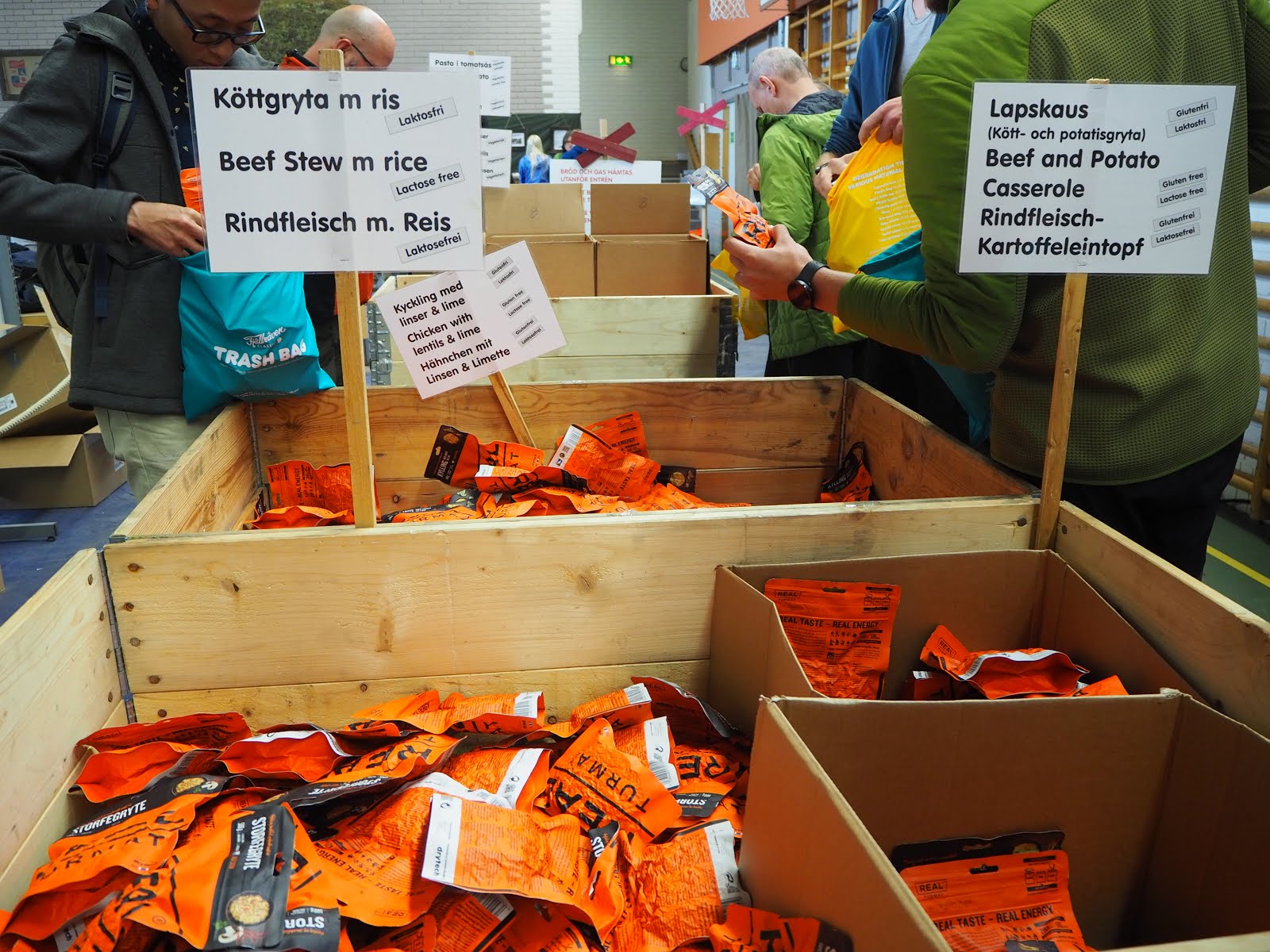
More options! Beef stew with rice was good too. There were other options we saw along the trek at the Salka and Alesjaure checkpoints as well.
There is also a pop up store by Naturkompaniet selling Fjällräven goods and also the Classic Event t-shirts and hoodies. We personally bought a t-shirt and a hoodie each! They're so comfy haha.

The last thing in the main hall is the Trekker's cafe selling some munchies and drinks. Now, if you get the collapsible cup for 25kr, it's a free flow of coffee and tea. That seemed like a good deal, so we got it and we did not regret it because those cups came in so handy on the trek!!

Trekkers Cafe

Collapsible cup - it's also a collectible!
Outside the hall, there was another pop up offering samples of freeze dried food. So, we got to try them and then we actually went back to change some of our options to the ones we thought were more yummy! I really enjoyed their service at the base camp.

There is also another station for fuel and polar bread. This is the only time you'll get the polar bread, so we took 6 pieces. The bread tastes really good actually! It's like an aerated flat bread that's really light. Please make sure that your stove is compatible with the Primus gas, especially if your stove is new and it's not the Primus brand.

The last station is for luggage check in. We didn't do this till 6am the next day, when we were about to take the bus to Nikkaluokta. You will need your trekking pass for this - they will write down your number and it will be used as a method of identification at the end when you collect your luggage.

The whole process at check in doesn't take very long, but you can feel free to stay as long as you like to soak in the atmosphere!
Be sure to check back for my subsequent posts on the trek itself!
Subscribe to:
Posts (Atom)