Pages

Fjällräven Classic Sweden Day 0: Check in

Hi everyone!

I'm going to write in detail about my experience every step of the way, so if you don't like spoilers, I'm gonna stop you right after this post. I think the check in process is rather important and informative for your planning purposes, so you should check it out before you reach Kiruna.

Fjällräven provides free bus transport from Kiruna airport and Kiruna train station to the base camp at Kiruna, so you don't have to worry about that. However, you have to make your way to Kiruna yourself, from whichever part of the world you're at. Now, I would recommend flying into Kiruna if you don't like long and unreliable train rides because it takes more than 12h to reach Kiruna from Stockholm by train and the train tracks got derailed so we had to take a bus from Bogden station, which took even longer ):

The base camp is at a school campus and it's very well-organised. When you enter the main hall area, there will be a queue for you to get your trekking pass and luggage tag, and thereafter, the trash bag, map, waterproof plastic bag, and then the freeze dried food. There is also a whole lot of information about the happenings during the week of the hike, bus timings, rules etc. on a noticeboard. If you have any questions, I'm sure the lovely volunteers would be glad to help you out!

Entrance to the main hall

Start of the queue for checking in!

Information Board near the start of the check in


Overview of the trek - We took 2.5 days worth of food because that's how long we felt we needed to hit the Salka checkpoint.

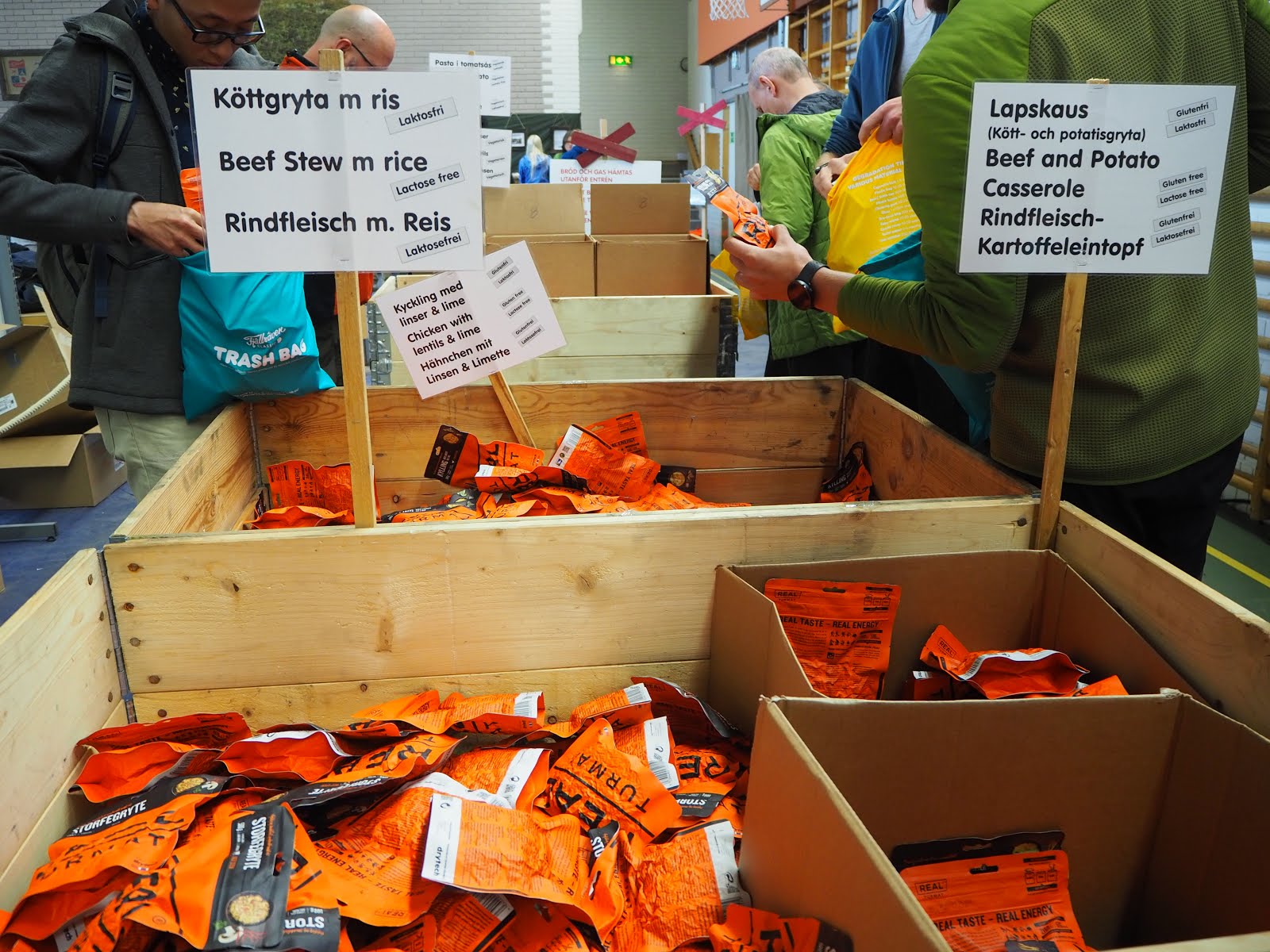
Selection of Freeze-dried food by Real Turmat - they're REALLY good. I personally loved the chocolate muesli for breakfast. There's another muesli with berries and coconut option that's called "Light meal". It contains 700 kcal as compared to 400kcal for the chocolate muesli. Just something to take note of!

They give you recommended number of meals to take! I personally loved the Creamy Salmon with pasta.

More options! Beef stew with rice was good too. There were other options we saw along the trek at the Salka and Alesjaure checkpoints as well.


There is also a pop up store by Naturkompaniet selling Fjällräven goods and also the Classic Event t-shirts and hoodies. We personally bought a t-shirt and a hoodie each! They're so comfy haha.


The last thing in the main hall is the Trekker's cafe selling some munchies and drinks. Now, if you get the collapsible cup for 25kr, it's a free flow of coffee and tea. That seemed like a good deal, so we got it and we did not regret it because those cups came in so handy on the trek!!

Trekkers Cafe

Collapsible cup - it's also a collectible!


Outside the hall, there was another pop up offering samples of freeze dried food. So, we got to try them and then we actually went back to change some of our options to the ones we thought were more yummy! I really enjoyed their service at the base camp.


There is also another station for fuel and polar bread. This is the only time you'll get the polar bread, so we took 6 pieces. The bread tastes really good actually! It's like an aerated flat bread that's really light. Please make sure that your stove is compatible with the Primus gas, especially if your stove is new and it's not the Primus brand.


The last station is for luggage check in. We didn't do this till 6am the next day, when we were about to take the bus to Nikkaluokta. You will need your trekking pass for this - they will write down your number and it will be used as a method of identification at the end when you collect your luggage.


The whole process at check in doesn't take very long, but you can feel free to stay as long as you like to soak in the atmosphere!

Be sure to check back for my subsequent posts on the trek itself!

A guide to the Fjällräven Classic Sweden: Do’s and Don’ts

When I was preparing for the Fjällräven Classic Sweden, I found that there was a lack of information on what I should do or how it’s like. This post is therefore an overview of the entire trek, having gone through it once. I’ll be sharing my lessons learnt, the type of terrain, weather, and gear you should bring for an enjoyable experience.

The Fjällräven Classic Sweden route uses the Kungsleden, or the King’s Trail, and it’s a very popular hiking route that the Swedish do. We saw quite a number of people embarking on the trail who weren’t part of the Fjällräven Classic. If you want to know more about the Fjällräven Classic Sweden, feel free to explore their website. They do have quite a comprehensive amount of information, but I just found it useful if I had heard from a past participant's experience!

Weather
The temperature in August is about 15 degrees Celsius in the day and 5 degrees Celsius at night. As you hike, your body produces heat. So, it can get pretty warm after 1-2 hours. However, when the wind blows, it does get pretty chilly. I found myself having to remove and put on my jacket multiple times during the day. At night, it does get cold. Wear a thicker pair of socks to sleep - those suitable for winter would be great. Also, wear a thermal layer with a fleece jacket and ensure that your sleeping bag can keep you warm till about 0 degrees Celsius. That way, you’ll be warm enough to sleep. The overall weather on the trail is generally unpredictable - but expect rain. It’s almost a guarantee that it will rain at some point in time during the hike. We were lucky this year - it only rained half the time. There were some years when it rained everyday!

Terrain
Living in Singapore meant that there was no way for me to train for the terrain. It is 70% rocks and 30% wooden planks to go through those places that are water-logged or contain too many uneven rocks. You also have to cross some shallow rivers. It’s very important to have a sturdy pair of waterproof boots. They will protect your ankles and toes as you navigate your way through the rocks, and I don’t know about you but I hate wet footwear, so the waterproofing to me was key in the river crossings. To me, the rocks were the part that made the trail difficult, not the distance or the load.

Wooden planks covering parts that were harder to cross


Rocky terrain that you'll be experiencing 70% of the journey


Do’s and Don’ts
  1. Be prepared for the rain - have a rain jacket that is AT LEAST 15,000 to 20,000 mm in waterproof rating. And also ensure that your backpack has a rain cover that is large enough for your whole bag, including the attachments that you’re adding on. I would also recommend waterproof pants that go over the boots, because the rain soaked my pants and the water dripped down my ankles into my boots, which resulted in soaking wet socks and boots, rendering my waterproof boots useless.
  2. Pitch your tent near a stream and on a flat piece of land with grass - seems like common sense but the stream was so important for us to refill our bottles, cook and also wash up in the morning. We pitched our tents near the checkpoints at Alesjaure and Kieron and they did not have running streams, which made it extremely inconvenient in the morning.
  3. Pitch your tent as soon as you know you’re going to stop for the day - we made the mistake of eating pancakes first instead of pitching our tent and then the rained came and all our things got soaked. So, if the weather is good and you know you’re done with your walking, just pitch your tent.
  4. Drink from clear, flowing streams - I loved drinking from the streams! It beats drinking from any water containers provided at the checkpoints because it's instant cold water that's fresh from the source. However, don't drink from the lake or very shallow streams because those contain a lot of impurities and the last thing you need is food poisoning on the hike.
  5. Pack as light as possible - this is a no brainer. You’ll be carrying your backpack over the course of 5 days. Only bring what’s necessary and your shoulders will thank you along the hike when they get fatigue. And ensure that you train with the same backpack and load too.
  6. Make lots of friends - you’ll meet lots of people who are going to be trekking at the same pace as you. The Fjällräven Classic isn’t a competition, so take time to stop and chat with fellow hikers, encourage them. It’s a rare opportunity for people to gather internationally so make the best use of the time to do so rather than huddle in your team!
Gear
This is the gear we used and I’ll be giving a short review on the necessity of them based on my experience. This post is in no way sponsored by anyone.
  • Backpack - Fjällräven Kaipak 28. It’s a little small and I had to place my sleeping mat outside and my boyfriend had to carry my sleeping bag. A 38L would be the minimum size if you want to carry everything yourself. My Boyfriend used the Kaipak 58 and together, it was sufficient for the both of us.
  • Tent - Decathlon Arpenaz 3 man tent (3kg). Space was sufficient for both of us and the setup was self-explanatory and easy enough. Also shelters from the rain well and withstands the wind.
  • Jacket - Columbia Ski Outer shell with inner down padded jacket. It’s an old jacket and I can’t remember the model but Ski-jackets are not waterproof enough and not breathable. Though there were pit-zips, I found myself sweating in my jacket easily. It’s also not waterproof enough. Choose a jacket made using Gore-tex or the Fjällräven Eco-shell.
  • Shirts - I wore one short sleeve dry-fit shirt and brought a spare. The spare is useful in case you get soaked in the rain, but if you have a good outer shell you don’t need this.
  • Pants - decathlon youth hiking pants. It had a zip that allowed me to remove the bottom half but I didn’t need that function for the Classic Sweden. It wasn’t waterproof at all and after one round of rain, water was dripping from my pants into my boots. It’s best to get something more waterproof. I’m looking at the Fjällräven Keb trousers next.
  • Undergarments - I used the normal ones I would wear for running. Also brought a bikini as backup and for the sauna.
  • Sleep wear - Uniqlo extra warm heat tech with an extra track pants and Columbia fleece jacket. This was sufficiently warm for me. 
  • Sleeping bag and mat - decathlon. They were 900g and 800g respectively. They were sufficiently comfortable to insulate us from the weather.
  • Stove - a random China made 3000W portable gas stove that’s compatible with Primus gas cans. I bought it from qoo10 for $17.10. It worked well and cooked about 1L of water in a few mins. It weighs 300g including packaging.
  • Pot - decathlon. I think you don’t have to be particular about this. Anything light and big enough for your usage would work.
  • Hiking pole - the cheapest decathlon one. It was sufficient for the purposes of providing support as we navigated through the rocks.
  • Slipper - Havaianas. It’s wateproof so that’s great, but I kept getting mud and sand on my feet, so I would suggest Crocs or something similar instead.
  • Boots - The North Face Storm Strike II. These are winter hiking boots, and they're completely waterproof, so that's super great. They also have a very sturdy base, but are really comfortable. I didn't get any blisters from them. The grip on these is also excellent, because they have ice pick grips that harden in the cold.
  • Socks - Wigwam. These were great. They don't absorb and retain too much sweat so it didn't feel extremely gross. I used one pair for the whole hike. 
  • Camera - I used my dad's Olympus OM-D E-M10 Mark II Mirrorless Camera, which is light but gives really good quality photos. However, it's not waterproof so when it rained I couldn't use it at all. If you have a phone with a really great camera, like the Huawei P30, I think that would suffice.
  • Powerbank - Xiaomi. My power bank was used to charge my phone and Garmin everyday and it lasted beyond the 5 days of hiking, so I think it's sufficient. 
  • Gloves - Cheap Korean wool gloves. I think they served their purpose well and not everyone hikes with gloves, but my hands get cold easily. 
  • Beanie - Montbell. I didn't use it at all in the end because it wasn't necessary. I think a cap may have functioned better. 
Those are all the main points I have to share! I will be blogging about my various days on the hike, as well as a more detailed one about the check in process. I will link them below once they're up! Hope this helps (: 

North Face Storm Strike II 

Decathlon Arpenaz 3 tent
One of the river crossings - reason why waterproof boots are important!

One of the many beauties on the trail

Read more about the Fjällräven Classic Sweden:

Powerman Malaysia Duathlon 2019 Race Report: My longest race yet

The Powerman Malaysia is an ASTC (Asian Triathlon Confederation) Middle Distance Duathlon, and it's also the race for the Asia Championships. There is also Powerman Indonesia but that's for the world series. In any case, it's a good race for Singaporeans because it's nearby and we only need to take a bus up together with our bikes. This is my second time participating in the Powerman Malaysia! Last year, I took part in the short category (5-30-5) because it was my first ever duathlon and I just wanted to experience how it was like. This year, I decided to just go for the classic distance since the short would be well, too short for my current standard. The classic distance is a 10km run, 60km bike and another 10km run (10-60-10).

Pre-race training
I only started training for powerman seriously towards the end of December 2018, because I was recovering from a ligament sprain from the Asics Relay on 20 October 2018. Tee Wei (my other half and coach) and I were doing a mix of sprint intervals, tempo runs and long distance runs every week since January 2019. As a result of that, I managed to comfortably clock sub 60 min 10km runs, which was pretty awesome for me. Cycling came in more at the end of January, but I only did a couple of rides before the race (less than 10). We did 3 brick trainings - 20km ride and 5 km run 4 weeks prior, then a 5km-30km-5km 2 weeks prior, followed by a 7km-40km-7km a week before the actual race. We tapered after the last brick training, only clocking 2 light runs. Unfortunately, I came down with food poisoning on Wednesday before the race so I was pretty much out and I only recovered the day before. Even so, I still experienced mild cramping of the stomach, which sort of affected me during the race itself. I'll elaborate more later.

D-1 to race day
Reached Lavender car park at 5.30am to load the bicycles and left at 6am. We followed the Newbie triathletes up this year, based on recommendation by Tee Wei's army friend Jonathan Kang, who runs the Tricators group. The trip up this year was smooth, so really thank God for that since last year I had the nightmare experience of the bus breaking down and reaching late for bike check in. We reached our hotel at about 1pm, checked in and then had lunch. We even had time to go for the race expo to check out the booths! Gels there are cheap so if you intend to come for Powerman, don't bother bringing gels, just buy them at the race expo. My friends and I also went for a light ride around the area before checking in our bikes at about 5.15pm (cut off time is 6pm, don't check in too soon because it's really hot and your tires may explode). I went to bed at 10.30pm that night!

Race day morning
Woke up at 5am (I had at least 6 hours of sleep! Thank God because it's more than I ever had since I always get race jitters.) and went down for breakfast - I ate 5 mini pancakes with honey, a banana and some koko krunch, which I felt was a reasonable amount to eat before a run. However, I didn't take into account the fact that my body was severely under-nutritioned the past few days as I was having diarrhoea, up till race morning. That cost me on the first run sigh. Anyway, we went to set up our stuff at the transition area at 6am and did some light jogs to warm up before the flag off, which was at 7am.

First run leg
I felt good for the first 3km or so, overtaking many people and pacing some. I was doing a 6 min/km pace, which was okay for me since I had to conserve my energy for the next 2 legs of the race. Then the pain started to come after the 3km mark. I started to feel slight amounts of hunger and pain in my stomach area. I was a bit worried because though it was tolerable then, it threatened to escalate further, which it did, till about a 4 or 5/10. I prayed and asked God for help, and successfully managed to complete the 10km with the pain. I still clocked a 6:06 min/km average but I was a little disappointed because I could have done better.


First transition
I ate the salted caramel gel and some energy jelly to combat my hunger pangs. Drank a bit of 100 plus and water and I was off onto my bike leg.

Bike leg
I felt good at the start of the bike leg, thanks to the gel and the jelly. Also, after the first run, Tee Wei waited for me at the transition area so we were going to do the rest of the race together (him at my pace obviously). The bike course was hilly, which was rather painful on the legs for the up slope. Interestingly, I was able to overtake people on the up slope but they would overtake me on the down slope - I think after my 2 crashes last year, I'm a lot more hesitant to go too quickly on the bike. In any case, I thought that the route was alright, except for this one lane area that stretched about 5km to and fro. It was more like a dirt road, with 2 roundabouts and I felt that it was rather dangerous because people were overtaking on a one lane road and there were some who stopped at the roundabouts to rest. It felt like a disaster crash waiting to happen. Each bike loop was 30km, so we had to do that twice. After that single lane area on my second loop, I completely lost momentum and for the remaining 15km or so, I just couldn't seem to get it back anymore. As a result, my bike leg was 20 min off my target timing. Then again, I had only clocked 2 rides over 60km in my life prior to that, so it was also expected that after the 45km mark, I lost the endurance on my bike. I was grateful to be off the bike at the second transition.

Second transition
I ate my caramel macchiato gel and the rest of the energy jelly. I chose to take caramel macchiato in the second transition because I knew that I needed the extra caffeine kick. Sprayed some sunblock on and I was off.

Second run leg
We managed to clock at 6:06 min/km pace for the first 2km. I was rather impressed with myself because I felt good, even after the slow bike leg due to fatigue. That didn't last long. After the 3rd km, the shade from the buildings and trees disappeared and we were out in the hot sun at 11am. I rejected all the water stations previously as I felt that I didn't need it at that point in time and was intending to take water at the 5km mark. However, I didn't know that my body was going to severely over heat and I was extremely dehydrated and feeling feverish at the 4km mark. I pressed on, till the sun got even hotter and I couldn't take it eventually. Slightly before the 5km mark, I had to walk in order not to let my body over heat. I was rather depressed at that point because I wanted to complete the entire race without walking. I prayed and asked God for strength to continue the second half of the run. We made it to the 5km water point and I downed water, 100 plus and poured multiple cups of water on my body, which cooled it down significantly. We continued running after that and I felt alright. From then on, I drank water/100 plus and wet my body with sponge periodically at every water station. Thankfully I was running with Tee Wei, who asked for the 1.5L water bottle and carried it with him from the 7km water point onwards, because that was the last water station. We used the water to cool our bodies down in the shadeless portions of the run and that enabled me to last till the end of the race. My shoes were water-logged as a result but I couldn't care less at that point.

The photographer said "You pretty lah, chantek" after he took this shot. I was too tired to respond at that point in time but I was quite happy hehe.

Final timing
I clocked 4:46:52 according to the race result, 9th in my age category. It isn't good, but I tried my best! Also, this is the first time I'm trying out the race so I'm also getting a feel of it. I will continue to train my runs - my aim is to get it down to a 55 min pace for 10km this year. I definitely need more work on the bike and I need to do more round island rides and climb more hills, train stand up paddling, work on my glutes more and continue to build up my core strength even more. I will come back next year and aim to do better!

I definitely would not have been able to do this race without relying on strength from God to pull me through the toughest moments. I'm also thankful to Tee Wei who ensured my well being during the race, since we saw more than 5 ambulances cart people off the race course.